
The Stable Business Series
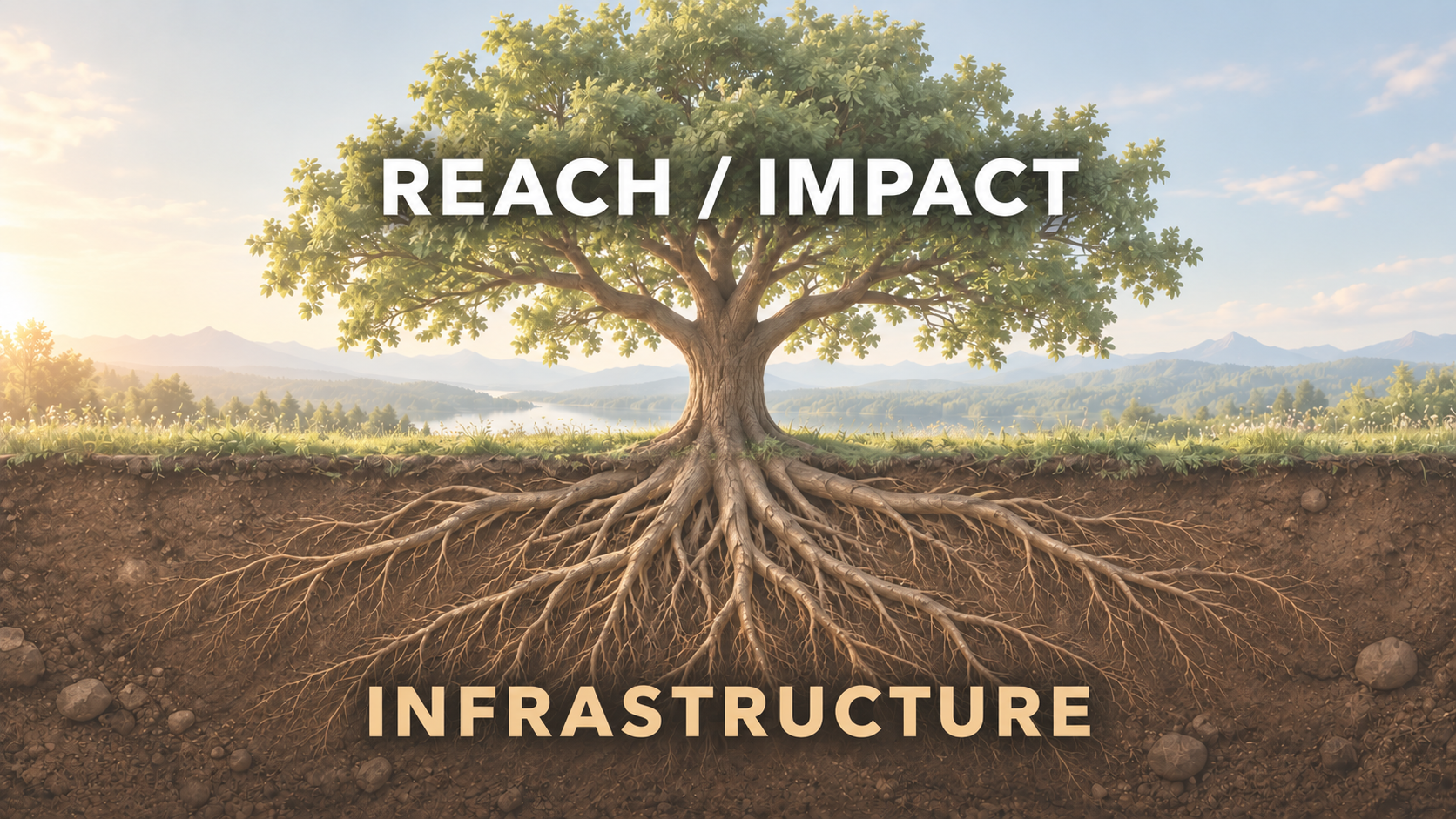
Impact Without Infrastructure Doesn't Scale
A compelling mission can start a company. It cannot sustain one.
I have worked with mission-driven entrepreneurs for decades, across natural products, renewable energy, health, technology, media, and social impact. Again and again, I have seen founders develop genuinely innovative ideas capable of improving lives or addressing serious environmental problems.
They are passionate about the change they want to create. They understand the problem. They believe deeply in their solution.
But too often, they devote nearly all their attention to the product and its impact — and not enough to building the company required to deliver that impact at scale.
That is where many promising ventures begin to stumble.
A Mission Is Not an Operating Model
Impact entrepreneurs frequently start with a different motivation than conventional founders. They are not simply searching for an attractive market opportunity. They see something that needs to change and feel compelled to do something about it.
That sense of purpose can be an extraordinary source of energy. It inspires employees, attracts early supporters, and keeps founders moving through uncertainty.
But purpose alone does not answer the practical questions every company must eventually confront:
- Who will pay for the solution?
- What will it cost to deliver?
- How will customers learn about it?
- Can the company generate sufficient margins to survive?
- What systems are needed as the organization grows?
- Who has the skills to lead each stage of development?
- What kind of capital is appropriate — and when?
- How will the company protect its mission as new investors, employees, and partners become involved?
These questions may feel less inspiring than developing the product or articulating the vision. Yet they determine whether the vision ever reaches more than a small number of people.
What Do We Mean by Infrastructure?
When people hear the word “infrastructure,” they may picture factories, warehouses, transportation systems, or technology platforms. Those can certainly be part of it.
But a company's infrastructure is much broader.
It includes its business model, financial systems, marketing strategy, operating processes, governance, partnerships, team, culture, and access to capital. It is everything that allows a promising idea to become a functioning enterprise — and enables that enterprise to grow without losing its balance.
This infrastructure is rarely visible to customers. It is not usually the story that appears on the front of the package or at the beginning of an investor presentation.
But it is what makes the story possible.
A breakthrough product without an effective path to market remains a breakthrough that few people experience. A growing company without financial controls can become more vulnerable with every new sale. A powerful mission without healthy governance can be compromised by the very capital intended to help it expand.
Growth magnifies what already exists. It does not automatically correct what is missing.
Scaling the Impact Means Scaling the Organization
Many founders talk about scaling their impact when what they really mean is selling more products, serving more people, or entering more markets.
Those are valuable outcomes, but they are the result of scale — not the foundation for it.
Before impact can scale, the organization must develop the capacity to support it. That means building a company able to make sound decisions, manage resources responsibly, communicate its value clearly, and adapt as conditions change.
It also means recognizing that the strongest impact businesses are not divided into two separate parts: one that makes money and another that does good.
The impact has to be integrated into how the enterprise operates.
How are products sourced and produced? How are employees treated? How does the company make decisions? What happens when financial pressures conflict with stated values? Is the business creating enough economic value to continue fulfilling its purpose?
A company becomes sustainable when its mission and its mechanics reinforce one another.
Infrastructure Should Evolve With the Business
Building infrastructure does not mean burdening an early-stage venture with the systems and overhead of a large corporation.
Not every element needs to be fully developed on day one. Early-stage companies are always works in progress. The challenge is to understand what must be built, in what sequence, and what risks the company is accepting when an essential capability is missing.
A startup may not need a large finance department, but it does need to understand its cash position and margins. It may not need a complex governance structure, but it does need clarity about decision-making and ownership. It may not need a national marketing campaign, but it does need a credible path to finding and converting its first customers.
The right infrastructure is not the most elaborate structure. It is the structure appropriate for the company's current stage and its next stage of growth.
Build the Company the Mission Deserves
Impact businesses face a difficult paradox.
They are created because the need is urgent, but urgency can encourage founders to move forward without building the structure needed for lasting success.
The answer is not to slow innovation or burden an early venture with unnecessary corporate machinery. It is to build intentionally — to create the right infrastructure for the company's current stage while preparing for what comes next.
The objective is not growth for its own sake. It is the capacity to deliver meaningful value consistently, responsibly, and at a scale proportionate to the problem.
A mission deserves more than enthusiasm. It deserves a company strong enough to carry it.
Impact without infrastructure may inspire people. It may attract attention. It may even achieve early success.
But it rarely scales — and it seldom lasts.
This article is part of an evolving series exploring what it takes to build companies that are not only sustainable in what they offer, but stable, responsible, and resilient in how they operate. These ideas will be developed more fully in my forthcoming book, The Stable Business.